Payload Insurance for Experimental Satellites
A shrinking insurance market leaves experimental satellites uninsured and underwriters risk-averse.

The space insurance market was built around a different kind of satellite than the ones now launching by the hundreds. High-value geostationary assets that carry hundreds of millions in revenue have deep, mature coverage markets with decades of actuarial data behind them. Experimental satellites and smallsats, by contrast, sit in a structural blind spot: too small and unproven to attract standard underwriting terms, yet carrying real financial and mission risk if lost. That mismatch is not a temporary market condition. It is a feature of how the market was designed.
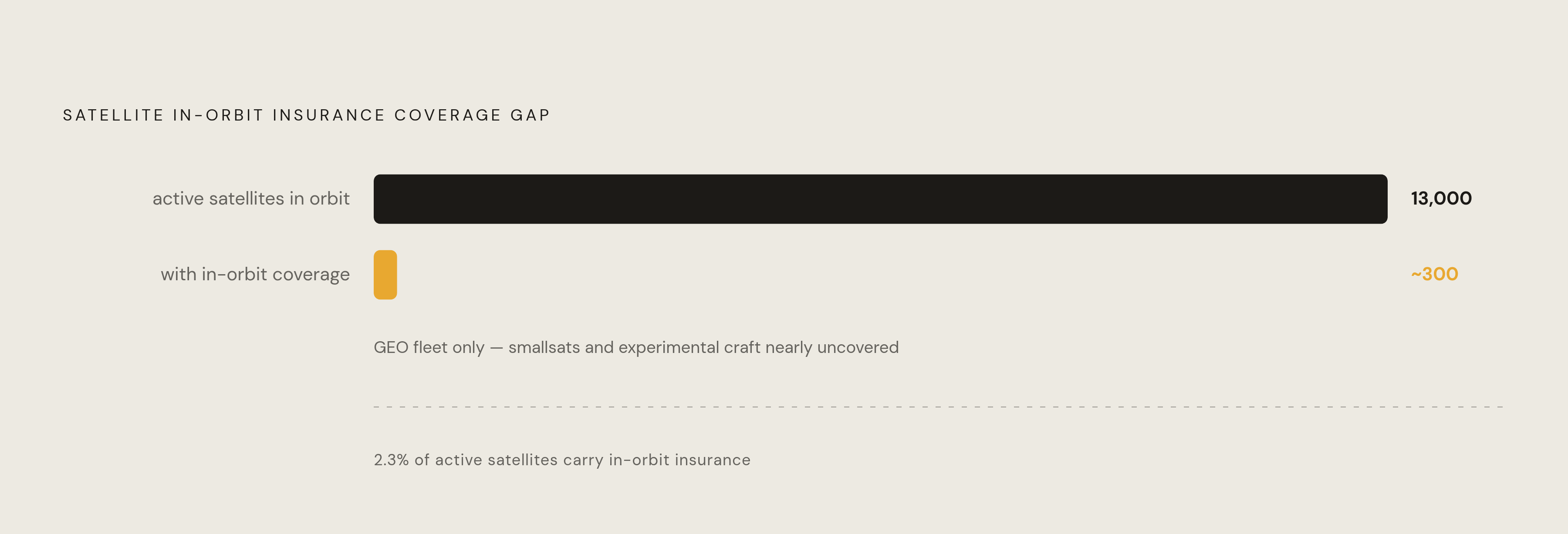
The penetration figures tell the story plainly. Of roughly 13,000 active satellites in orbit, only around 300 carry in-orbit coverage. That number already understates the problem because it includes the heavily insured GEO fleet, the segment where capacity concentrates and terms have been negotiated for decades. Among traditional high-value GEO assets, insurance penetration is high. The experimental and smallsat segment is a different story entirely. An experimental payload on a new bus architecture with no flight heritage does not fit that architecture, and the market has little incentive to reshape itself for a customer base that represents a fraction of the premium pool.
How consecutive loss years hardened the market against the riskiest missions
The structural mismatch alone would make coverage difficult for experimental operators. Recent loss history has made it harder still. The 2023 loss year broke the market's capacity base, and the SpainSat NG-2 loss at the end of 2025 reset it again. Each reset leaves experimental missions competing for a shrinking pool of risk appetite. Capacity does not recover quickly in this market: underwriters who absorbed losses on one cohort of risks become more selective about the next, and the missions with the thinnest actuarial track record absorb that selectivity first.
Competitive capacity remains well below peak levels, and the categories that attract underwriting interest have narrowed accordingly. New technology, unique, or challenging risks now sit significantly below the mainstream threshold for appetite. A proven GEO operator with fifteen years of telemetry can still place coverage, even in a hard market. Underwriters become more selective, and the selection criteria root out precisely the missions that most need coverage as a condition of their business model.
What underwriters actually see when an experimental satellite submission lands on their desk
Market conditions set the frame. The submission itself determines what happens inside it. When an experimental satellite submission lands on an underwriter's desk, the underwriter reads it against five primary variables: launch vehicle reliability score; satellite bus architecture and manufacturer heritage; orbital parameters, including GEO versus LEO risk differentials, debris conjunction exposure, and thermal cycling frequency; insured value construction, meaning replacement cost basis versus loss-of-revenue extensions; and operator anomaly resolution track record. Each of these is a place where an experimental submission can either answer the underwriter's questions or leave them open.
The cost of an open question is that underwriters fill information gaps with worst-case assumptions. That practice is standard, not discretionary. Heritage claims are the clearest example. Operators frequently mis-present heritage by counting all flights, including test and demonstration missions. Underwriters disaggregate this data, weighting commercial payload missions with documented telemetry far more heavily. Submitting undifferentiated flight counts signals a lack of underwriting sophistication, and underwriters price that signal accordingly. A submission that conflates test flights with operational missions tells the underwriter that the operator does not understand what the underwriter needs to see, and that alone justifies a higher premium.
The timing of risk also shapes the pricing. Launch and Early Orbit Phase dominates premium because propulsion anomalies, deployment failures, and communication lock-out events concentrate into that narrow window. The longer the evaluation, the more conservative the assumptions.
An in-orbit operator reduced renewal premiums materially, and that is the strongest evidence that submission quality moves pricing. The reduction was not driven by a loss-free record alone. The operator submitted a proactive mid-term anomaly resolution report documenting an attitude control anomaly, its root cause, the corrective action taken, and the outcome. When an operator demonstrates that it identified an anomaly, diagnosed it, corrected it, and can document each step, the underwriter's assessment shifts from "unknown risk" to "managed risk." That distinction is worth money.
The coverage lines relevant to experimental payloads and where each one breaks down
Understanding what coverage exists requires mapping the lines an experimental operator might reach for, then identifying where each one fails. Each line has a specific failure mode when applied to autonomous or unproven spacecraft, and understanding which line covers which risk is prerequisite to building coverage that holds at claim time. Pre-launch and inland marine coverage protects satellites in transit, integration, and launch-site operations. Its failure mode is temporal: coverage ends at separation or handover, so a deployment failure in the first hours of orbit may fall in a gap between pre-launch and in-orbit policy inception. Aon's Q1 2026 report notes the Astranis Utilitysat remained in transfer orbit after propulsion issues in early 2026, leading to a total loss claim. That case shows how pre-launch coverage transitions into LEOP exposure, and how the boundary between them is where claims get contested.
Launch and in-orbit coverage addresses the riskiest window, from launch through the first year in orbit, when most failures occur. The failure mode here is structural: coverage is typically structured around a known satellite value, and experimental satellites with unclear replacement cost or no revenue model create insured value disputes at claim time when the operator cannot demonstrate what the asset was worth. The FAA does not require operators to insure the payload itself. Government-backed commercial contracts now require substantial coverage thresholds per mission, raising the floor for operators pursuing those customers.
Technology errors and omissions coverage, along with professional liability, seems most naturally suited to software-driven satellite failures, but the wordings were drafted for terrestrial software contexts. An autonomous spacecraft can cut across cyber, professional and technology E&O, property, general liability, and products liability simultaneously, creating genuine ambiguity about which policy responds when a claim arrives. Cyber coverage carries the sharpest failure mode in the whole map: the market has no viable product for satellite command-and-control exposure. Direct and officers coverage rounds out the map, with exposure growing as space startups take on institutional capital and government contracts, where uncertainty about mission risk can produce high rates as underwriters limit exposure to unknown liabilities.
The structural gaps that standard policies leave open for autonomous spacecraft
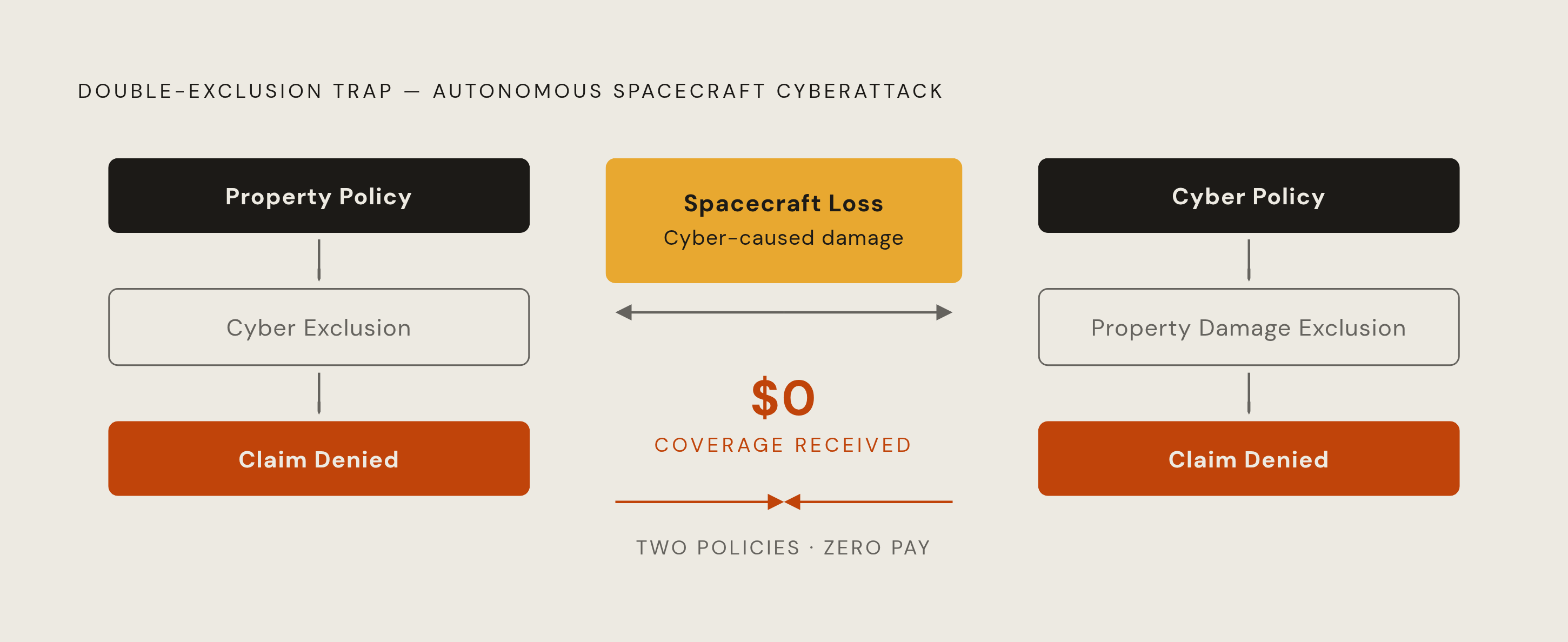
Autonomous spacecraft face a specific structural hazard that standard policy architecture was not designed to address. Consider the double-exclusion trap: a cyberattack against an autonomous spacecraft that results in property damage can be excluded under a property policy because of a cyber exclusion, while also falling outside the scope of a cyber policy because of a property damage exclusion. The operator holds two policies, both respond to real risk categories, and neither pays. This is not a hypothetical edge case. It is the predictable outcome of applying policy wordings drafted for terrestrial operations to in-orbit autonomous systems whose failure modes do not respect the boundaries those wordings assume.
The exclusion landscape is actively worsening. AI exclusions are proliferating, and the regulatory record is clear. Berkshire Hathaway, Chubb, and Travelers sought state regulatory approval to exclude AI-related damages from general liability policies, and state regulators approved more than 80% of those requests. Losses arising from autonomous AI decision-making can still be covered, but only if they fall within the insuring agreement and are not otherwise excluded, and many wordings predate widespread autonomous systems deployment. The policy language was written for a world where machines did not make the decisions that caused the loss.
The scope of the gap extends beyond any single exclusion. Emerging risks including autonomous spacecraft, in-orbit servicing, space tourism, and lunar infrastructure are categorized together by specialist analysts as largely uninsurable, with no actuarial basis. That phrasing is precise: the coverage gap for the most novel mission profiles is not a pricing problem but an availability problem. No premium level makes the risk insurable because there is no data to price it against. The strongest objection to this analysis is that operators can structure policies to avoid these gaps. The answer is that doing so requires a broker who reads the actual policy language before binding, not one who slots an experimental satellite into a generic commercial property form. Most standard brokers do not have the specialist knowledge to identify a double-exclusion trap in a space policy wording. The submission reaches the wrong carrier, and the gap is invisible until claim time.
What coverage requirements are buried in launch contracts and customer agreements
The coverage gap is not only a risk management problem. It is a contract compliance problem that shows up before a satellite ever launches, in the fine print of launch services agreements and customer contracts. FAA third-party liability is mandatory for any entity conducting a licensed launch or reentry, with Maximum Probable Loss requirements typically ranging from $100 million to $500 million depending on vehicle, trajectory, and launch site. The FAA does not require payload insurance, but launch service providers often impose their own insurance requirements through the launch services agreement, independent of the regulatory floor. An operator that has satisfied the legal minimum may still be in breach of its commercial obligations with the launch provider.
Government-backed commercial contracts now require substantial coverage thresholds per mission, and an operator without compliant coverage cannot execute the contract regardless of technical readiness. Enterprise and institutional customers are embedding insurance requirements into payload integration agreements, data purchase agreements, and hosted payload arrangements, often without the operator noticing until the contract review stage. The pattern is consistent: the requirement appears in a document the operator reads for technical terms, not for insurance obligations. The consequence of discovering a coverage requirement at contract execution, rather than during mission planning, is a compressed timeline to place coverage. Compressed timelines produce higher premiums and less favorable terms in a hard market. The operator pays more for worse coverage because the discovery came late. Insurance placement should begin at the same time as launch vehicle selection, not after a customer contract is signed.
How to build a submission that closes the gap rather than confirming it
For experimental satellite operators, the underwriting submission is the primary instrument for closing the coverage gap, and its quality determines both whether coverage is available and what it costs. A complete submission removes the underwriter's ability to assume worst-case. It specifies launch vehicle heritage correctly, distinguishing commercial payload missions with documented telemetry from test flights. It documents the satellite bus architecture and manufacturer lineage. It constructs insured value on a defensible replacement cost basis. Each element replaces an area of uncertainty with a specific, verifiable answer.
Documented anomaly resolution is among the most effective premium levers available to operators with any flight history. A proactive mid-term report documenting an anomaly, its root cause, corrective action, and outcome directly reduced renewal premiums by 18% for one in-orbit operator. The reduction did not come from a loss-free record alone but from transparency that demonstrated risk management capability. An operator that documents its failures well is a better risk than one that hides them, and underwriters reward that distinction with real pricing.
Carrier selection matters as much as submission quality. Specialist carriers who explicitly underwrite autonomous and experimental missions evaluate a submission on its actual risk profile. A generic broker placing the same submission with a standard commercial property carrier will trigger exclusions and mismatches that no amount of documentation can fix. Submission quality determines the premium and the coverage, but only if it reaches a carrier whose policy was written to cover the risk being described. A specialist broker who reads every policy before it binds is the mechanism that connects a well-prepared submission to coverage that actually holds at claim time, identifying double-exclusion traps, AI exclusions, and cyber carve-outs before they become claim denials. Broker commissions are already baked into the premium regardless of whether a specialist or generalist places the policy. Working with a specialist costs nothing beyond what the operator would pay through a standard broker, while the coverage quality difference is material. The gap is structural, but the path across it is specific, and it begins with the documents the operator submits long before the claim ever arrives.