The Operational Risk Profile That Makes Warehouse AMR Fleets Unplaceable Through Standard Commercial Lines
AMR fleets need coordinated coverage that standard commercial policies cannot provide.
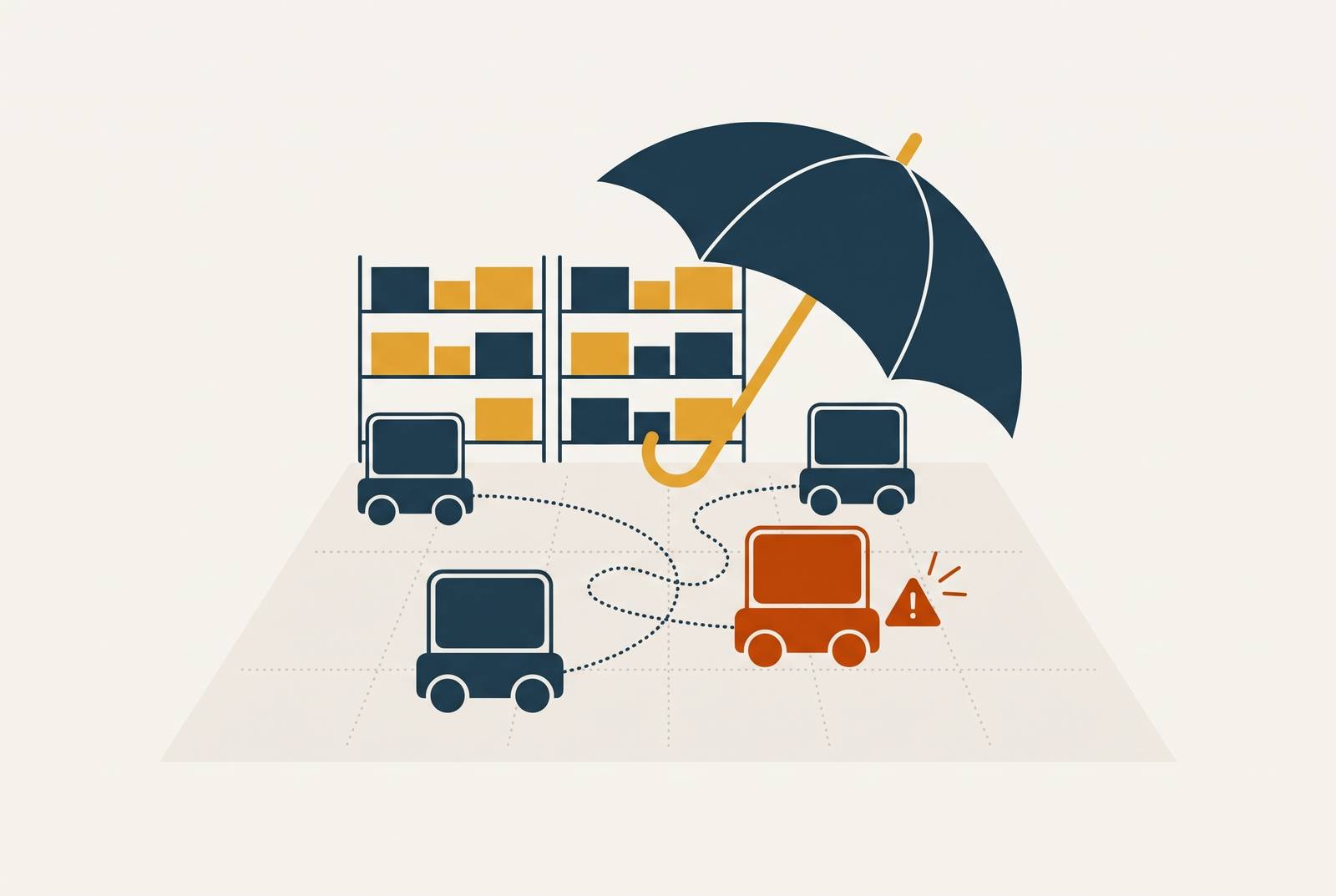
Warehouse AMR fleets can be unplaceable through standard commercial lines because their risks cross policy boundaries that a generic warehouse program leaves unresolved. An insurance broker for autonomous systems and robotics companies should build a coordinated program around software-driven physical loss, fleet-wide disruption, and multi-party liability. The broker must know how to choose autonomy-specific forms, underwrite the operations, and check how the policies respond together.
Why warehouse AMR fleets sit at the intersection of every major commercial coverage line simultaneously
A single AMR collision can damage racking and inventory, injure a nearby worker, and interrupt outbound dispatch. Property, general liability, workers’ compensation, and business interruption exposures converge immediately. If the navigation error traces back to a software update, tech errors and omissions or cyber coverage also enters the analysis. One event crosses several different policy boundaries. The warehouse is therefore not simply adding equipment to an otherwise unchanged risk profile.
The resulting losses can extend beyond the collision itself. Rack collapse, compromised temperature-sensitive inventory, and contractual service-level failures can follow a robotic malfunction. Battery charging areas bring electrical and thermal hazards together in one place, while dense goods-to-person layouts change how firefighters get in and how smoke moves. These operating conditions are interconnected. Standard commercial lines divide the risk into products even when the underlying operation cannot be divided that way.
How the liability attribution problem fragments responsibility across parties standard policies treat as one
It can be hard to work out whose actions caused the loss. An AMR deployment divides responsibility among the OEM, software or control platform provider, systems integrator, and warehouse operator. Each controls a different part of the system. A policy written for one party does not automatically absorb the liability of the others, while interconnected decisions make root cause analysis slower and defense costs harder to contain.
A worker death and resulting five-company lawsuit involving industrial or collaborative robots illustrate this fragmentation. The example establishes neither fault nor an outcome here. It shows why a robot-related injury can implicate several businesses rather than resolve into a claim against one machine owner. Workers’ compensation may respond to the injury while product liability claims proceed against a manufacturer or integrator and the operator faces third-party litigation.
Software updates make it harder to determine whose actions caused a loss: a firmware change that alters braking behavior or route logic gives a physical injury a potentially digital cause. Over-the-air updates are a standard fleet management feature, so this boundary problem is part of ordinary operations. Premises GL and product liability coverage can leave opposing gaps if the operator’s form does not respond to the alleged cause and the OEM’s form excludes software-driven behavior.
What the ISO AI exclusion endorsements do to general liability coverage for AMR operators and manufacturers
ISO’s AI exclusion endorsements took effect in January 2026, giving insurers clear wording they can use to exclude specified AI-related losses from general liability coverage. Adoption is not automatic across the market. ISO supplies the wording, but each insurer decides whether and how to use it. The bound policy’s exclusions therefore determine the scope of coverage under its commercial general liability declarations.
IMA Financial Group’s July 2026 analysis describes endorsements aimed at generative AI, which they define broadly as data-trained, machine-based systems that can generate content or responses, including code. AMR navigation, perception, and orchestration systems require careful comparison with the actual definition. Calling a system AI does not by itself show that every robotic function falls within a generative AI exclusion. Where the wording applies, however, it replaces an interpretive dispute with an express coverage restriction.
For manufacturers, Products/Completed Operations is especially consequential because it is the natural location for post-sale injury claims. Exclusions in that coverage can take away the protection expected when a robot in use causes harm. Buying CGL does not establish that autonomous physical operations are insured.
Why tech E&O does not automatically fill the gap that general liability leaves open for software-driven physical loss
Tech E&O addresses technology-related wrongful acts and performance failures, but it does not automatically accept losses excluded by GL. Its coverage depends on its own trigger and exclusions. A robot control error can damage equipment, produce defective output, or shut down a whole facility, but a form written for technology services may not cover those physical losses. The handoff between policies must be established in the wording.
The same analysis identifies tech E&O as a potential bridge where GL and cyber leave gaps. That bridge requires deliberate form selection. A policy that does not contemplate physical loss from software failure offers limited protection for the injury or property damage associated with fleet operations. Some carriers have also introduced AI exclusions into tech E&O and specialty liability, including broad wording that can reach beyond generative AI.
The application creates an earlier obstacle. Standard tech E&O applications have no fields that ask specifically about autonomous physical operations, fleet orchestration logic, or over-the-air update liability. Without an explanation of those functions, the submission may describe a different risk from the one the company actually presents. The underwriter needs that translation before suitable coverage can be considered.
How cyber exposure in AMR fleets produces correlated loss patterns that standard cyber forms were not priced to cover
AMR cyber exposure is concentrated in shared dependencies. Fleet coordination relies on orchestration software and WiFi or private wireless networks. Interference, coverage gaps, or outages can impair the entire fleet, although those failures are not necessarily cyber events. Corrupted orchestration software can likewise create simultaneous operational disruption. Underwriters must assess the concentration of loss behind one shared system.
That issue should not be confused with a claim that cyber models universally assume independent failures. The British Actuarial Journal’s cyber-insurance pricing models paper describes frameworks that assume correlated aggregate loss amounts and counts. The FSI/IAIS report nevertheless identifies the difficulty traditional actuarial models face with cyber risk’s non-stationary and systemic characteristics. Correlation is recognized, but recognition does not establish adequate pricing for autonomous physical operations.
In a smart warehouse, linked sensors, AI platforms, robotics controllers, and cloud systems can allow one vulnerability to cascade across operations. Business interruption and third-party liability may arise together. A shared perception algorithm can also produce correlated failures under particular environmental conditions without any cyber attack. Underwriters therefore need to assess how the fleet depends on shared systems, since a standard cyber policy may not cover every loss that follows.
How the duty-of-care standard is shifting for operators who deploy AI-driven systems, and what that means for D&O and management liability
The exposure extends to the people governing deployment. AI systems used for early detection create questions about what the company knew, whether an alert was reviewed, and why a decision was overridden. IMA’s analysis describes a shift toward prevention and oversight that can be trusted, backed by records of how concerns are escalated and how models are governed. An ignored warning can turn a lapse in day-to-day operations into a possible failure of controls.
Management liability wording can restrict the response to that allegation. Absolute AI exclusions in D&O filings apply to claims that stem from AI use, deployment, or development, whether it happened or is only alleged. Their scope can extend to AI policies and procedures, failure to detect third-party AI output, and alleged breaches of duty involving AI. Wording like this can also affect E&O and fiduciary coverage.
The scope of these exclusions makes form review indispensable to understanding the exposure. For founders and executives who make public statements about autonomous-system safety or reliability, a governance allegation may engage personal financial exposure as well as corporate liability. Operational insurance alone does not resolve that question.
Why the safety certification gap makes AMR risk illegible to standard actuarial models in the first place
Traditional safety standards assume deterministic behavior, where the same input produces the same output. AMRs using machine learning can adapt through operational experience, making their behavior harder to predict in advance. A loss may involve design, training, data, operation, or unanticipated behavior. That uncertainty weakens both causal attribution and the predictable loss profile standard pricing requires.
Historical evidence is also limited for this relatively new category. OSHA’s severe injury reporting requirement began on January 1, 2015, covering work-related amputations, in-patient hospitalizations, and loss of an eye. It did not create reporting for every non-fatal robot incident. Minor incidents remain outside that requirement, leaving an incomplete basis for assessing frequency and severity across AMR operations.
Without enough evidence of how systems behave and what losses they cause, carriers may refuse to cover them, price them cautiously, or limit coverage through exclusions and sublimits. The certification gap is therefore both a technical concern and an underwriting constraint. API underwriting is a new way to get performance, utilization, and operating-domain data straight from fleets. That evidence can serve as a proxy for missing historical statistics, without making adaptive systems deterministic or removing the need for policy scrutiny.
Why the multi-party contractual structure of a typical AMR deployment creates coverage gaps that no single policy in the program can close
The OEM, software provider, integrator, and operator may each buy coverage from different carriers, using different triggers and exclusions. If an injured worker sues the operator first, the operator needs a defensible primary response before recovery from another party is resolved. Ultimate responsibility and immediate insurance response are separate questions.
The installation contract shapes how those questions interact. Acceptance testing, patch responsibility, indemnity for bodily injury or property damage, and remote access control set out what each party must do and what the insurance must cover. Contractual indemnities, additional insured status, vendor insurance requirements, and evidence of upstream limits therefore belong in the pre-installation assessment. They cannot be treated as paperwork that becomes relevant only after a claim.
The landlord may insure the building on assumptions that no longer describe its charging infrastructure or dense robotic layout. Describing the operation as “a warehouse with some robotics” leaves material operating conditions unexplained. Cross-border deployments can add jurisdictional complications, including for operators in India working with multinational OEMs.
Why submission quality is the variable that determines whether a specialist carrier can write the risk at all
Specialist placement becomes possible when the submission makes autonomous operations legible to an underwriter. Robot counts alone do not accomplish that. Underwriters need to understand how the facility degrades during failure, whether manual operation remains possible, and whether aisle segregation limits human-robot interaction. Tested emergency stop and restart protocols help show how losses are prevented and who is responsible after an incident.
The evidence for property coverage must show where and how charging and maintenance take place. Relevant details include charging-room compartmentalization, fire segmentation, thermal monitoring, preventive maintenance, spare-parts discipline, and OEM battery certification. These facts show how the operation controls concentrated hazards. They also address conditions that a generic warehouse application may never ask about, allowing assessment of the actual facility.
Manufacturers must give an equally clear account of how they govern their software. Over-the-air update protocols, version control, and the scope of behavior changes permitted without re-certification explain how the product changes after deployment. Acceptance testing and upstream risk transfer complete a picture that generic forms leave unfinished. Better evidence can turn an otherwise opaque submission into a risk a specialist can evaluate, although it does not guarantee terms or acceptance. The broker’s contribution is the translation of operations into an underwritable account.
What should an AMR operator or manufacturer look for in an insurance broker and coverage program?
Operators and manufacturers should look for a broker who approaches coverage as a coordinated system. The broker should check whether the bound GL form excludes AI-driven physical operations and choose tech E&O that covers software-driven physical loss. Additional insured provisions and vendor requirements should support the intended primary response and upstream recovery. Each policy must have a defined role.
Equipment and inland marine coverage should contemplate mobile, connected, software-updated assets. The property submission should explain charging infrastructure, rack interactions, and dense layouts, supported by compartmentalization, thermal monitoring, and battery certification evidence. Cyber review should address correlated fleet-wide loss and the business interruption trigger for corrupted orchestration software. Limits alone do not show whether the policy covers a shutdown.
A suitable specialist goes to carriers that explicitly cover autonomy and reads each policy before binding. Founders and operators should describe what they build and deploy in plain language, then allow the specialist to draft the application from that operational account. Broker commissions are built into the premium whether a specialist or generalist places the policy. The practical choice is therefore about the work performed, including accurate submissions, coordinated forms, and clear identification of the gaps that remain.