Which Carrier Panels Have Actually Built Underwriting Appetite for Autonomous Vehicle and Robotics Manufacturer Liability
Specialist carriers assess software updates and shared liability, not just accident limits.
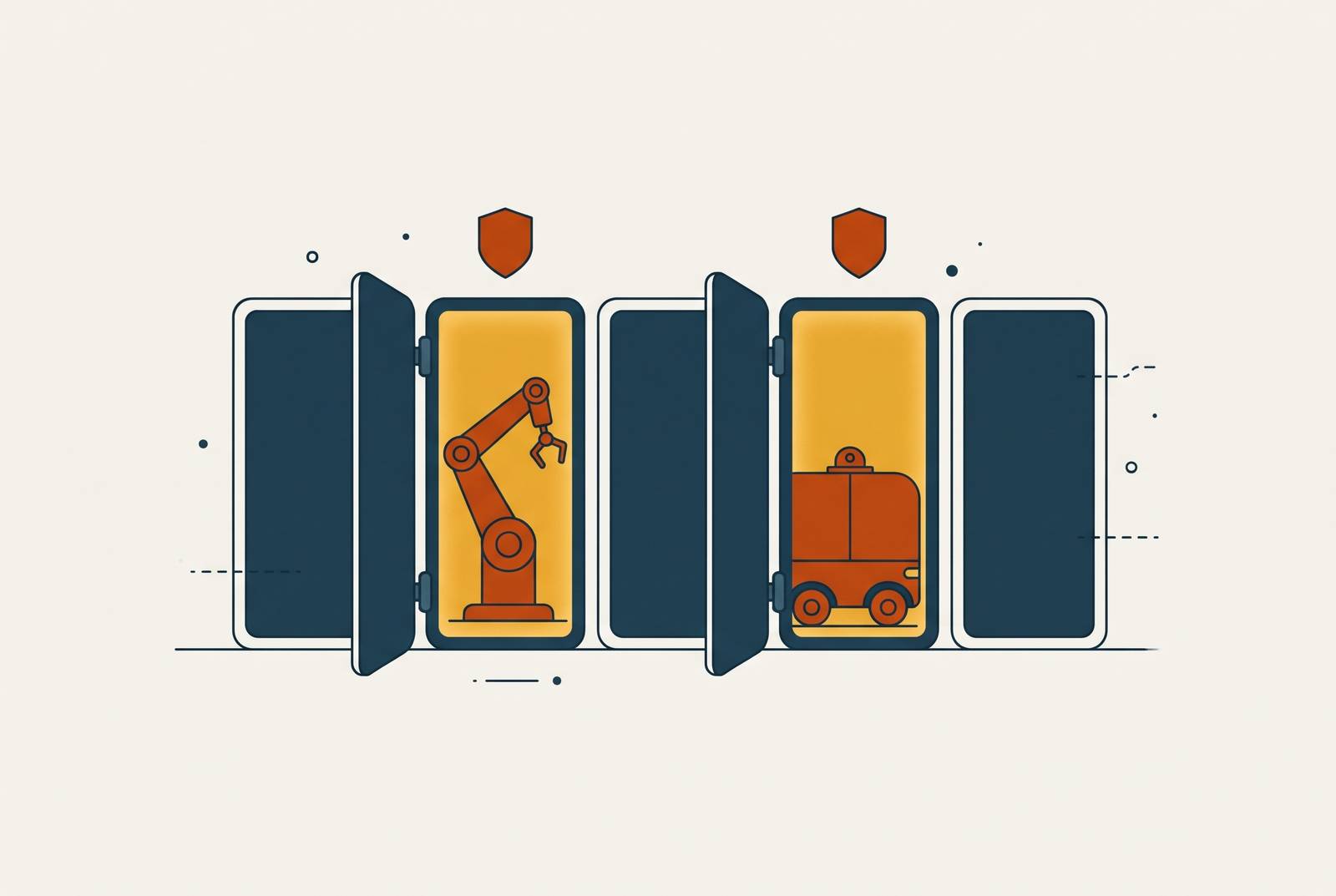
An insurance broker for autonomous systems and robotics companies should show that it can reach underwriters who assess software updates, safety governance, and shared liability, as well as offer product liability limits. The policy must cover software-driven physical harm without exclusions that conflict with that coverage. Carrier appetite is visible in the wording before a claim.
Why standard product liability forms fail autonomous and robotics manufacturers before a claim ever happens
“Product liability” sounds as though it covers the harm a robot or autonomous vehicle causes when its product fails. For an autonomous hardware manufacturer, however, perception software is a potential source of defects alongside physical components. The distinction changes the coverage analysis. Standard commercial general liability and product liability forms were written for hardware whose risk profile stays much the same after it is made, while these systems can change what an entire deployed fleet can do overnight.
An over-the-air update can change perception algorithms, planning heuristics, or control parameters without changing the hardware the insurer originally evaluated. An underwriter assessing version 4.2 of a driving stack may face a materially different exposure at version 4.3. A standard annual policy has no mechanism to reprice or requalify that change.
Responsibility is also harder to isolate than a conventional manufacturing defect. A single incident can implicate the hardware maker, software developer, system integrator, and operating company. Xiaodan Lin, Chen-Ying Lee, and Chiang Ku Fan’s 2025 study, Exploring the Impacts of Autonomous Vehicles on the Insurance Industry and Strategies for Adaptation, identifies multi-party liability complexity as insurers’ primary concern. Standard forms assume a more bounded product and traceable defect, while the performance data needed to assess an AI system often remain with the OEM. Choosing a carrier thus depends on how well it can assess the exposure as well as how large a limit it can offer.
How the AI exclusion wave of 2026 is quietly voiding coverage that autonomous hardware companies thought they had
ISO released three generative AI exclusion endorsements effective January 1, 2026. Their scope differs in consequential ways. CG 40 47 excludes bodily injury, property damage, and personal and advertising injury arising out of generative AI across Coverage A and Coverage B. CG 40 48 removes only Coverage B, which addresses personal and advertising injury. CG 35 08 applies the exclusion to the products and completed-operations coverage part, making it particularly relevant to manufacturers.
These exclusions are limited to generative AI. Their effect depends on the attached wording and the exposure involved. Nevertheless, ISO forms underpin the vast majority of U.S. property and casualty policies, so these endorsements create a broad route for removing coverage at renewal. An unchanged limit provides no reassurance about that change.
Berkshire Hathaway, Chubb, and Travelers asked state regulators to let them exclude AI-related damages from general liability policies, and the regulators approved more than 80% of those requests. W.R. Berkley’s absolute AI exclusion reaches D&O, E&O, and fiduciary liability. Such proprietary exclusions can be broader than the ISO endorsements, without a generative AI limitation or confinement to one coverage part.
For an AV or robotics company renewing a standard commercial policy in 2026, the practical response is a specific question to its broker about whether CG 40 47, CG 40 48, CG 35 08, or a proprietary equivalent has been attached. Silence is not evidence of unchanged coverage. A familiar-looking renewal can remove the exposure that made the insurance necessary.
What the coverage stack actually needs to look like for an autonomous or robotics manufacturer
A specialist underwriter looks at how at least seven coverage lines cover the exposure from autonomous hardware. Commercial general liability supplies baseline third-party bodily injury and property damage coverage, but technology exclusions and CG 40 47 can restrict its response. Product liability addresses injury or property damage caused by a defective robot or AV system. For that protection to match the product, its wording must contemplate software defects, OTA-update-triggered failures, and defective physical components.
Tech E&O usually addresses financial loss from software errors and integration failures, but most standard forms exclude bodily injury. This creates the critical seam in the program. If Tech E&O excludes bodily injury while the liability policy excludes technology-related harm, a software failure that physically injures someone can fall outside both. Two policies do not necessarily produce joined-up coverage.
Cyber liability adds coverage for data breaches and for remote exploitation of connected robots. In smart factories, a vulnerability can cascade from IoT sensors through AI platforms to robotics controllers, creating business interruption and third-party liability together. Standard general liability forms commonly exclude damage to “electronic data.” The underwriting task is therefore to distinguish data loss from the physical consequences of a cyber event and address the overlap explicitly.
Commercial property and inland marine cover hardware, prototypes, and units deployed in the field, which standard property exclusions for transit or field equipment can leave without coverage. Product recall serves a different purpose. Standard liability insurance generally does not pay the first-party costs of recalling, retrofitting, replacing, or withdrawing an affected fleet, which require specialized recall coverage where available. D&O rounds out the coverage for companies with outside directors or institutional capital, though absolute AI exclusions can remove coverage for governance decisions about autonomous deployment.
The cases that are now pricing the market and what they reveal about where standard forms broke
Waymo recalled thousands of robotaxis in 2026 after a software glitch caused vehicles to enter closed freeway construction zones. Vehicles either failed to recognize ramp-closure signs or inappropriately prioritized avoiding other freeway hazards. For underwriting, the event connects software performance to fleet-wide corrective costs, exposing the distinction between third-party liability protection and the separate expense of addressing defective deployed systems. It does not establish how any insurance claim was paid.
Cruise faced combined regulatory fines from NHTSA, the DOJ, and California’s CPUC for safety and reporting failures. Simultaneous federal and state enforcement shows why an AV program cannot be evaluated solely by its bodily injury limit, because standard liability forms do not address the full range of regulatory action. Nor does the existence of a fine establish that it is insurable.
The market has also seen a nine-figure AV verdict, so large liability losses sit alongside the risks of fleet correction and enforcement. Those are distinct underwriting problems. A carrier willing to price accident liability has not necessarily accepted recall costs or regulatory risk, and a program’s relevance cannot be inferred from one broad coverage label.
What genuine underwriting appetite looks like versus a generic placement that happens to touch AV or robotics
Revenue and loss history remain inputs, but they do not explain how an autonomous system changes after deployment. A carrier that assesses the actual exposure asks about software versioning, how often OTA updates happen, and who governs those updates and how. It also examines safety architecture and the division of responsibility among the parties supplying and operating the system. A generic product submission leaves those distinctions unresolved.
The first test checks whether the underwriter asks for that information before offering terms. The second is whether the resulting wording affirmatively addresses AI navigation or perception failures that cause bodily injury or property damage. An expression of interest is not enough. The third is whether Tech E&O and product liability respond coherently when software causes physical harm, rather than exclude the same event from opposite sides. The fourth test examines which AI and technology exclusions the carrier will remove or narrow, and what safety documentation it requires in return.
Axis Insurance built a program with explicit coverage for bodily injury and property damage from AI navigation or perception failures. It also includes physical damage caused by a cyberattack taking over a robot’s controls, and production losses when a software update or sensor failure takes a robot offline. These are designed program elements rather than manuscript additions negotiated afterward.
HSB, a Munich Re company, launched AI Liability Insurance for small and mid-size businesses in March 2026 with a standard limit of $50,000. Larger AI vendors can get products with higher limits, including Munich Re’s aiSure program. That is evidence of differentiated AI insurance offerings, with each product’s fit for a robotics manufacturer’s bodily injury exposure still an open question. What a product covers and how much it will pay need separate checks.
Safety conditions can also signal genuine appetite. An underwriter requiring documented safety architecture or kill-switch documentation is evaluating how the insured controls the risk. By contrast, an absolute AI exclusion that does not distinguish a consumer chatbot from a deployed Level 4 AV system removes that distinction from coverage altogether. For startups and companies deploying autonomous mobile robots in warehouses, the relevant comparison is therefore not which panel will accept an application, but which will price the specific deployment and express that acceptance in its policy.
How contract and regulatory requirements expose the coverage gap companies don't know they have
Enterprise insurance requirements can expose a deficient placement before an accident occurs. Contracts increasingly require explicit endorsements for autonomous use and the customer’s inclusion as an additional insured. A generic product liability certificate does not satisfy that requirement merely because its limit is large. The endorsement is part of the commercial obligation.
Florida sets a separate insurance requirement for fully autonomous vehicles operating with the automated driving system engaged while logged on to an on-demand autonomous vehicle network or engaged in a prearranged ride. The requirement calls for primary automobile liability coverage for that operation. A standard commercial auto or general liability placement with technology or AI exclusions cannot be treated as equivalent simply because it insures the company.
The EU digital omnibus regulation on AI entered into force July 27, 2026, deferring the main Annex III high-risk requirements from August 2, 2026 to December 2, 2027. The June 2026 amendments also delayed certain obligations to December 2027 or August 2028. Those dates are separate from the revised EU Product Liability Directive, which entered into force December 8, 2024 and must be transposed by December 9, 2026. The directive expressly brings software and AI within strict liability, creating a software-defect exposure that standard U.S.-form policies were not written to address.
Coverage adequacy also enters transaction scrutiny. Robotics due diligence routinely examines insurance, indemnity terms, incident history, regulatory posture, and safety documentation. An inadequate placement can therefore become a disclosed fundraising or M&A risk, even when the company has not experienced a covered loss.
How to choose an insurance broker for autonomous systems and robotics companies
The appropriate broker is one that can translate machines in the field into an underwriting submission and reach markets with genuine appetite. Specialist access has a concrete purpose. It connects the company with underwriters asking about OTA governance and safety controls, rather than markets accepting the application only after excluding its central exposure. For robots deployed in a warehouse, that means assessing the software-driven physical risk along with the risk of the units as manufactured equipment.
The submission should describe software update cadence and governance, deployment architecture, and the multi-party liability chain. It should identify who makes the hardware, who writes the software, and who operates the system. Safety architecture documentation, regulatory compliance posture, and enterprise customers’ insurance requirements complete that account. These are pricing inputs. Without them, an underwriter must price uncertainty.
A company choosing a broker should ask how the markets the broker proposes handle software-caused bodily injury, OTA-related failures, and AI exclusions. The answer should connect the submission to the proposed form. A lower premium on a narrower product liability policy is not an equivalent alternative if the software exposure has been removed, and specialty-placement commissions are already built into the premium whether a specialist or generic broker places it. The selection should turn on the submission’s quality and the coverage it obtains.