Liability Coverage Options for Companies Deploying Autonomous Robots in the Field
A single robot incident can span four policies, each with gaps.
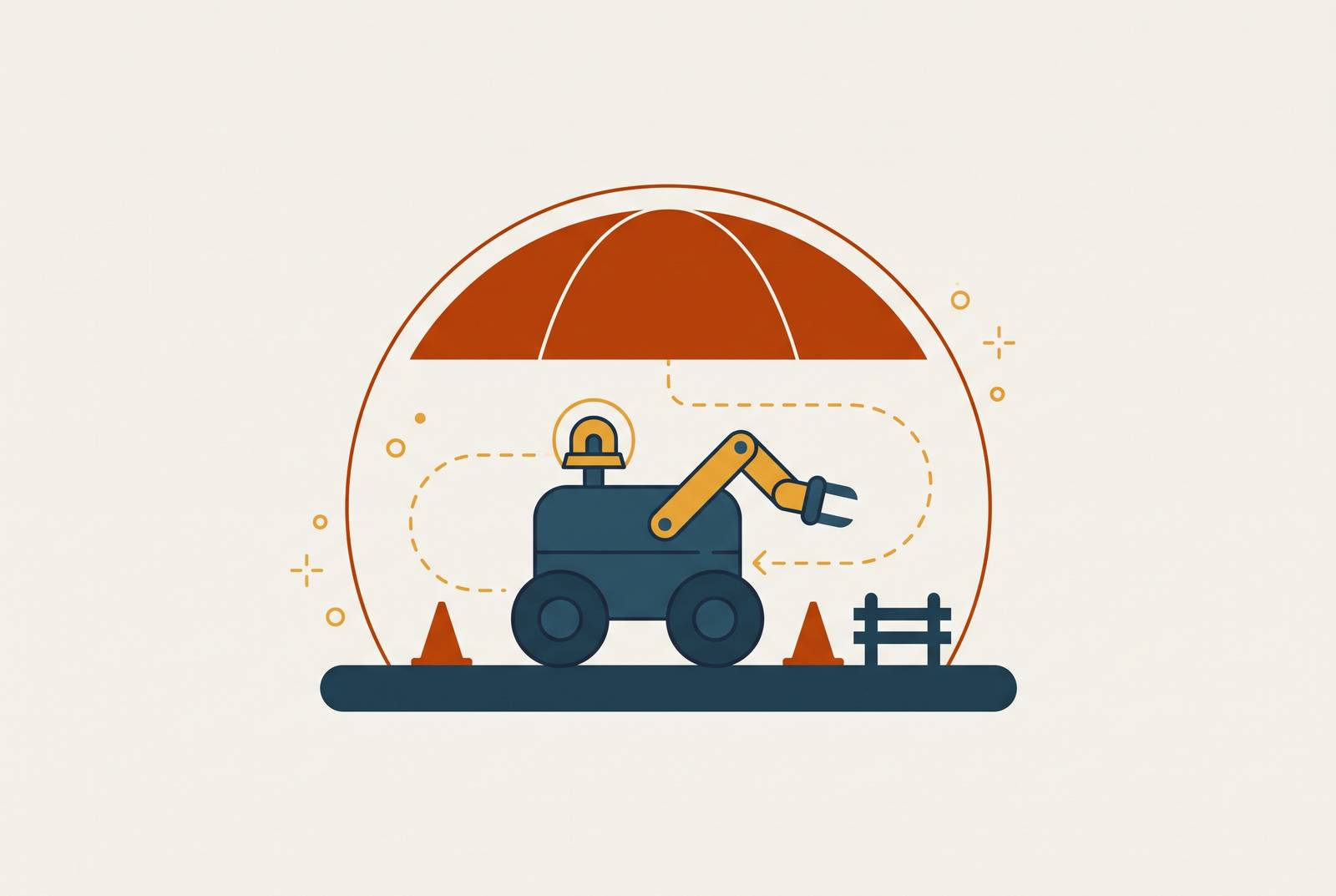
Autonomous robot liability cannot be covered reliably as a one-policy equipment risk. A single incident in the field can involve physical injury, software failure, cyber compromise, and damage to the robot itself. The foundation of a sound insurance program is matching each exposure to a coverage line, then examining the exclusions and boundaries that could leave part of the claim uninsured.
Why a single autonomous robot incident triggers multiple coverage lines at once
WTW’s physical AI analysis illustrates the problem with a warehouse accident in which a humanoid robot drops a heavy box on a contractor. The manufacturer may face a design-defect claim, while the software developer faces allegations that its algorithm misjudged balance. Inadequate safety procedures may implicate the operator, and a failed sensor may implicate the maintenance provider. One event opens several routes to liability. The injury is visible immediately, but the cause may sit across hardware, software, and operating procedures.
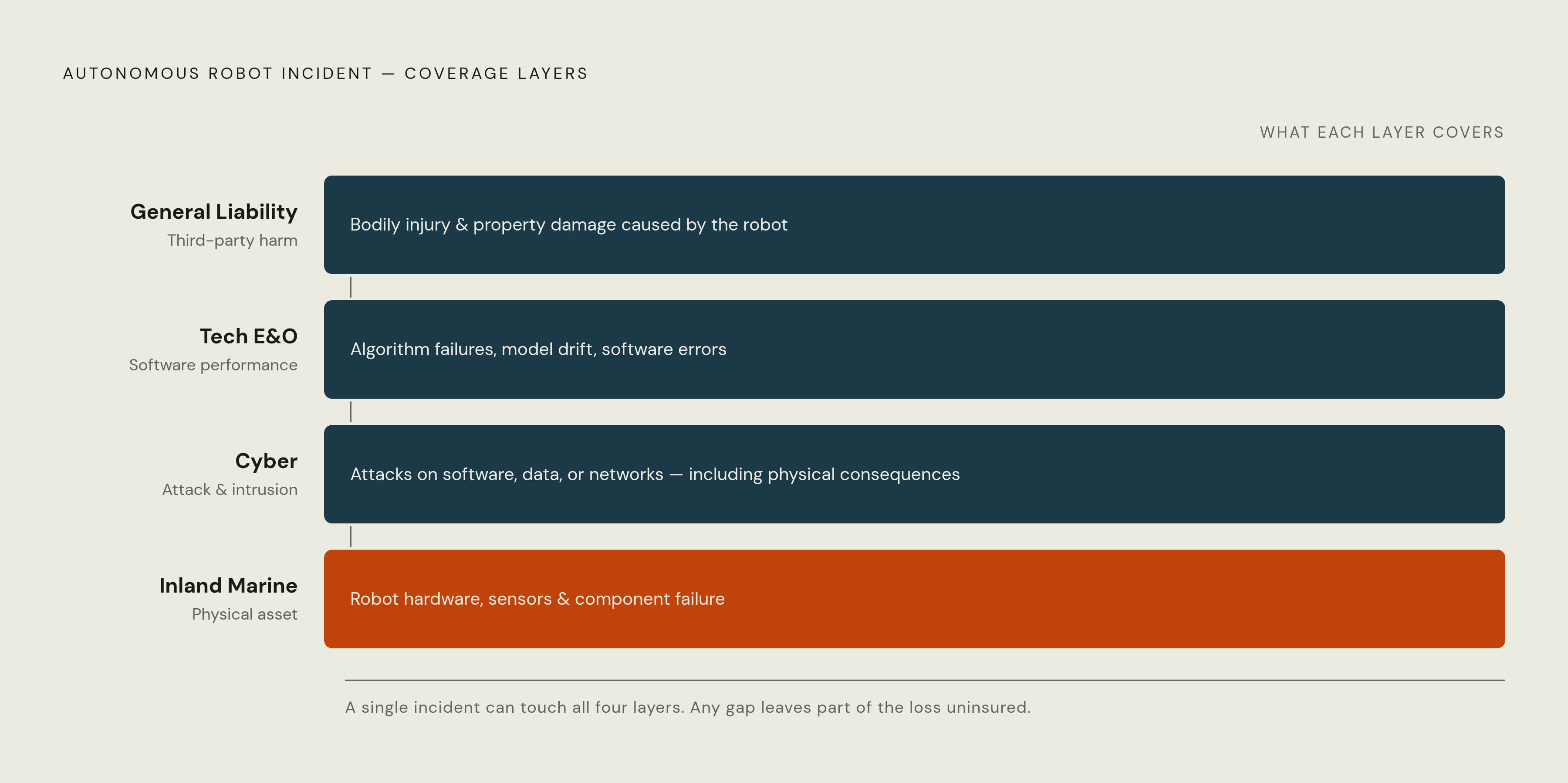
Sensors, software, and AI models determine how a robot acts as conditions change, so the decision-making layer becomes part of the physical exposure. A software decision, a physical outcome, and a cyber vector can converge in the same incident. If the robot is also damaged, its owner faces a property loss as well as potential liability to others. With only one or two policies, whole parts of a claim can go uncovered, leaving no payment for those losses. The four core coverage lines are general liability, tech errors and omissions, cyber, and inland marine.
How fault gets distributed across a supply chain when a robot causes harm
IMA Financial Group identifies a broad chain of potentially responsible parties in advanced manufacturing, including the robotics vendor, software provider, sensor suppliers, systems integrator, and maintenance contractor. Interconnected systems make fault harder to isolate. Root cause analysis can take longer, which adds to defense costs before the questions about coverage are settled. A cobot injury, for example, can implicate those who made, programmed, operated, owned, or supervised it. Workers’ compensation may respond to the worker’s injury while product liability claims proceed against the manufacturer or integrator.
Regulators and courts increasingly examine whether an AI-generated alert received human review, whether an override was documented, and whether the documentation was adequate. Failure to act on an alert can become an alleged control failure, even when another company supplied the underlying system. Contracts allocate duties, but they do not prevent disputes across the supply chain. An operator needs its own coverage written to address claims originating in another party’s component, rather than relying on that party’s insurance to absorb the exposure.
What general liability and product liability cover — and where they stop for autonomous systems
General liability provides the familiar starting point for bodily injury and property damage caused by robotic systems. Product liability covers defects in how a robot is designed or made. Yet an autonomous system complicates both categories because its algorithms help determine equipment behavior, process decisions, and output. IMA notes that policy response can depend on whether the relevant jurisdiction treats AI software as a product. The physical machine alone does not define the exposure.
Explicit exclusions further narrow that starting point. ISO issued three generative AI exclusions for commercial general liability in January 2026, namely CG 40 47, CG 40 48, and CG 35 08. CG 40 47 removes bodily injury, property damage, and personal or advertising injury arising out of generative AI under Coverage A and Coverage B. CG 40 48 is only for personal and advertising injury under Coverage B. CG 35 08 applies to products and completed operations liability, so those who deploy autonomous robots need to pay close attention to how it treats bodily injury and property damage.
Those endorsements concern generative AI, so whether they apply depends on the system and what the policy says. They should not be read as interchangeable exclusions for every form of automation. Even where physical damage remains covered, however, another gap persists. Standard product liability forms do not cover the production losses that follow when a robot failure shuts down a line.
What tech E&O covers that general liability leaves open
Tech E&O covers wrongful acts and performance failures that stem from technology. For an autonomous robot, those exposures include an algorithm misjudging a physical condition, an update introducing a performance failure, or a model drifting from its trained behavior and causing a downstream error. IMA describes how failures in code, data, or system logic can cascade into equipment damage, defective output, or facility-wide shutdowns. Software failure is therefore both a digital and an operational exposure.
A GL policy may cover property damage from a robot while excluding the AI-related cause of that damage. Tech E&O is designed to cover technology failures, but its own terms decide which losses from those failures are covered. Its role within a coordinated program is to address the software-decision layer, with coverage for losses excluded by GL subject to its own terms.
Armilla’s Lloyd’s-backed product, launched in 2025, illustrates the move toward affirmative coverage for AI system failures and “hallucinations.” Its performance-based triggers link payouts to deterioration below acceptable standards rather than relying solely on traditional incident-based claims. Such products serve a small market, with limits that are low compared with the cost of lawsuits that large deployments could face. A further complication arises when faulty software behavior results from compromise rather than an internal error, bringing cyber coverage into the same claim.
Where cyber coverage begins in a robot incident and why the boundary with tech E&O is blurry
Cyber exposure begins when an attack on software, data, or networks compromises the robot’s operation. Connected sensors, AI platforms, robotics controllers, and cloud systems allow a vulnerability to cascade across the deployment. Data poisoning can corrupt models, while a cyberattack can disable robots and halt production. The same compromised system can cause business interruption, property damage, and injury.
Axis Insurance provides a concrete example of coverage that bridges this cyber-physical divide. Its autonomous-robot program addresses physical damage caused by a cyberattack that takes over a robot’s controls, and its Cyber-Physical Loss coverage includes events where cyber causes physical harm or financial loss. For operators, the placement question is whether the proposed policy expressly addresses physical consequences, robotic downtime from a cyber incident, and third-party bodily injury or property damage. Coverage limited to data loss or digital assets does not address that full exposure.
The boundary with tech E&O remains difficult. OSHA guidance identifies programming, testing, and maintenance as settings in which robots may activate unexpectedly because of control or state-management errors. A cyber-induced state change could look like a software bug, making it hard to tell which coverage should pay. A specialist broker must address the seam at placement rather than assume either form will absorb the disputed loss.
What inland marine coverage does for the physical robot asset itself
Inland marine shifts the focus from liability to the robot as property. Standard property policies are written for assets that remain in one place, while inland marine addresses equipment that moves and operates in the field. Autonomous robots also depend on specialized semiconductors, sensors, and batteries that can be difficult to replace quickly. Their value and deployment conditions create a distinct equipment exposure. Protection for the machine itself therefore requires separate attention from coverage for harm it causes.
Operators assessing equipment coverage need to look closely at how the policy values the equipment. Replacement cost and actual cash value can produce different outcomes because hardware with fast-moving software dependencies depreciates rapidly. The form also needs scrutiny for coverage during transit and testing, explicit treatment of sensor and component failure, and software-related physical damage. Conventional equipment floaters may not contemplate those causes of loss. The way they cover industrial machinery may not fit the ways an AI-controlled robot can fail.
Downtime presents another boundary within property protection. Standard inland marine forms generally depend on physical loss and do not typically cover production losses when software alone takes a robot offline. Axis covers production losses caused by a software update or sensor failure even when there is no physical damage. That distinction separates protection for a damaged asset from protection against its inability to work.
How the AI exclusion wave is actively shrinking the coverage that standard policies once provided by default
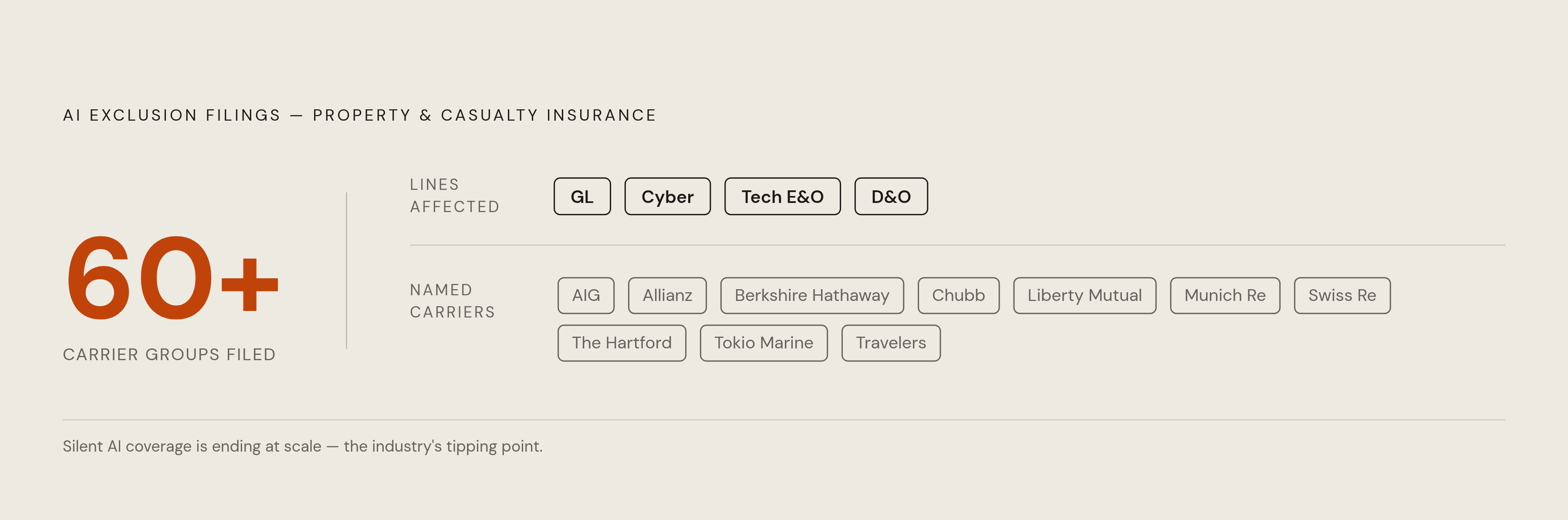
AI exclusions are changing what GL, cyber, tech E&O, and D&O cover. More than 60 property and casualty insurance groups have filed to adopt them across several business lines. The filing carriers include AIG, Allianz, Berkshire Hathaway, Chubb, Liberty Mutual, Munich Re, Swiss Re, The Hartford, Tokio Marine, and Travelers. Coverage that was thought to include AI may end when the policy is renewed. The policy limits alone do not show whether that coverage has changed.
W.R. Berkley’s absolute exclusion illustrates how broad the wording can become. Across D&O, E&O, and fiduciary lines, it addresses claims “based upon, arising out of, or attributable to any actual or alleged use, deployment, or development of Artificial Intelligence.” It provides no carve-back for autonomous operations. Meanwhile, board-level governance and disclosure allegations sit in a different coverage line from injury caused by an AI-controlled machine. When exclusions are written separately, they can leave gaps between those lines.
This shift marks the end of implicit, or “silent AI,” coverage. Insurers are moving toward express decisions about which AI risks they accept, partly against an accumulation exposure that is not geographically confined. A flaw in a widely deployed model can spread across businesses and countries, while privacy and liability claims may take years to develop. Operators can navigate the shift by examining exclusions and seeking explicit coverage where needed. Specialist markets are beginning to supply that affirmative language.
What affirmative AI coverage looks like and what it does not yet solve
Affirmative coverage explicitly names AI exposures. Axis’s program includes bodily injury and property damage from navigation or perception failures, as well as third-party component defects where the claim lands on the integrator. Those provisions address both autonomous decision-making and upstream dependency. They complement the program’s cyber-physical and nonphysical downtime protections. The scope is built around mechanisms that conventional forms may separate or overlook.
CFC’s June 2026 policy update expressly names model hallucinations, AI-generated content, and model drift across seven product lines, including Tech E&O, professional liability, and cyber. Armilla uses a different approach through the performance-based triggers described earlier. Allianz Partners’ September 2026 agreement with Waymo illustrates another route, supplying motor fleet insurance and product liability coverage for robotaxi operations. Initial deployment plans include Munich, with commercial launch targeted for the end of 2027, and London.
Their limits remain consequential for large deployments. Specialist AI products serve a small market, and lawsuits can cost more than the available coverage can pay. Nor does one policy comprehensively address claims against the hardware maker, software developer, and operator arising from a single incident. Affirmative language resolves uncertainty about named risks, but it does not eliminate the need to coordinate coverage across the full operation.
Why building a layered program requires a submission written for how the robot actually operates
Underwriters have less actuarial history for autonomous robots than for conventional equipment. The same robot can present different risks at different sites, software can change after placement, and operators set operating limits. A useful submission must describe those variables. It should explain the operating environment, software stack and update management, human oversight and escalation procedures, third-party integration risk, and incident response and claims notification processes.
Generic commercial forms do not ask enough of the relevant questions. Software versioning, sensor governance, model drift monitoring, and the division of responsibility among suppliers and operators are central to the exposure. A submission that omits them can look complete while leaving underwriters without the information needed to price and cover the risk. A specialist submission must connect operating practices to the requested policy language. Coverage scope and pricing depend on that connection.
Broker commissions are already built into premiums whether a generalist or specialist places the policy, so specialist placement does not inherently add a separate cost. Before binding, the broker must check how the forms cover the work the robot does, where triggers overlap, and which exclusions weaken the intended protection. That work must also account for exclusions introduced at renewal. A defensible layered program rests on a precise description of the robot’s operation and policy language written to respond to it.