What a Robotics Hardware Company Must Confirm About a Broker's Autonomous Deployment Coverage Record Before Any Carrier Submission
Ask whether your broker has placed real autonomous coverage.

Before a robotics hardware company authorizes a carrier submission, it must confirm that the broker has actually placed coverage for autonomous systems operating in the field. Adjacent technology or manufacturing experience is not enough. The relevant record includes autonomous coverage placements, exclusion negotiations, detailed underwriting submissions, and contract reviews that connect the policy to how the machines will operate.
Why the standard broker vetting process fails robotics hardware companies
Application forms, revenue, and headcount describe a business, but they do not adequately describe autonomous deployment risk. Carriers need to understand what a machine does without a person at the controls and how responsibility is divided when it causes harm. A broker can complete the application without accurately representing the exposure.
WTW’s 2026 analysis shows how software errors in physical AI can cause bodily injury, property damage, operational disruption, and disputes over liability that are hard to untangle. In a warehouse incident where a humanoid robot injures a contractor, responsibility may fall on the manufacturer, software developer, operator, or maintenance provider. That fault chain is central to the placement. A broker unfamiliar with it can misrepresent the risk without negligence, simply because conventional forms do not capture what the carrier needs to assess.
What actually goes wrong when an inexperienced broker submits for an autonomous system
An inexperienced broker may describe a conventional hardware business rather than an unmanned system operating in the field. The resulting policy can therefore respond incorrectly, or not at all, when a physical incident occurs. A higher premium is not the principal danger. The company may have bought coverage whose trigger conditions do not match the event for which it expected protection.
The mismatch becomes consequential when responsibility crosses the boundaries between hardware, software, operation, and maintenance. If the submission did not describe those relationships, the company can face exclusions or a dispute over whether the incident falls within the policy. Binding does not end the problem. A disputed claim creates a record that follows the company into future renewals, leaving founders to address both the incident and the insurance consequences of an inaccurate submission.
The coverage lines a broker must have actually placed for autonomous deployments — not just sold in adjacent markets
A broker’s experience with general liability and product liability must include how the multi-party fault chain works in an autonomous deployment. The submission must describe the manufacturer, software developer, operator, and maintenance provider accurately enough for the coverage to match how an incident could unfold. Generic product experience is not sufficient evidence. Without autonomous placement experience, a broker can miss the relationship between those responsibilities and the policy’s trigger conditions.
Cyber experience needs an equally specific physical dimension. IMA Financial describes how a vulnerability in connected robotics can corrupt AI models, disable robotic systems, halt production, and trigger claims for both business interruption and third-party liability. Tech E&O also requires attention to AI product output claims and affirmative coverage for those exposures. Digital-only experience leaves a significant gap in understanding.
Inland marine and equipment coverage must account for prototypes, lab gear, and field units moving between sites, demonstrations, and pilots. The placement depends on scheduling that hardware correctly. A broker without this experience can miss how the insured equipment travels and where it is deployed. D&O requires a different understanding, including AI governance, product safety oversight, capital-raising disclosures, and regulatory compliance. A generic D&O placement may fail to address those robotics-specific exposures.
Product recall addresses another gap that liability coverage does not fill. A defect affecting a deployed fleet can create first-party recall and retrofit costs that a standard liability policy does not pay. A broker who has never placed recall coverage for hardware may not raise the line at all.
How the ISO AI exclusion wave has changed what an experienced broker must know before submitting
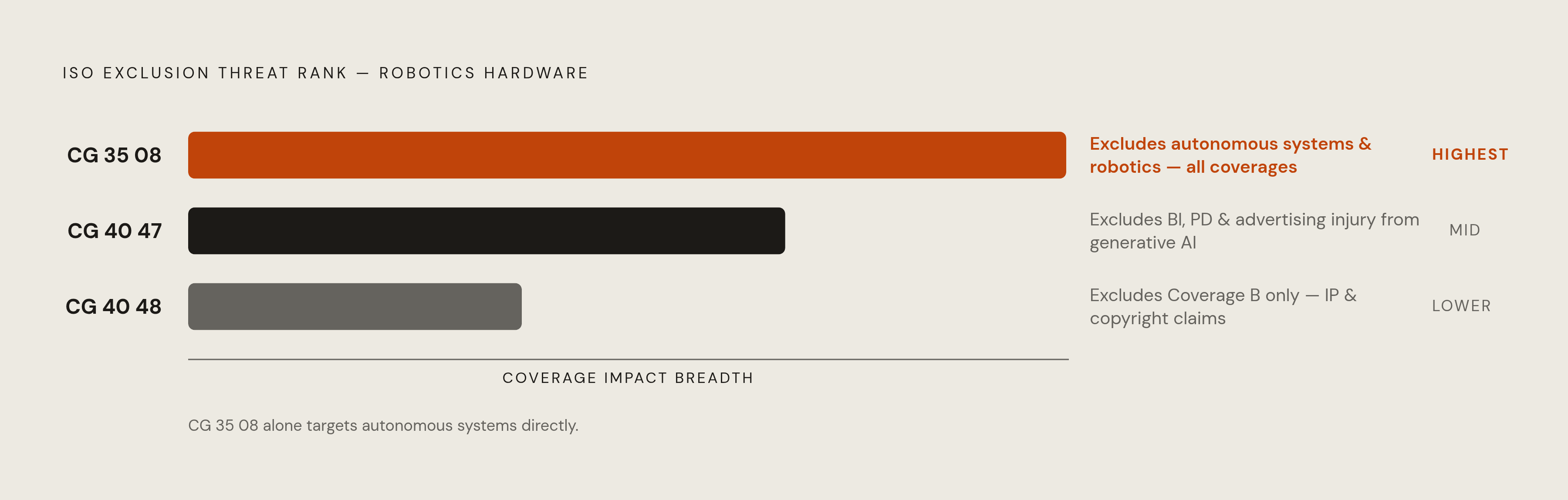
ISO AI exclusions make current form knowledge essential to autonomous hardware placements in 2026. CG 40 47 removes bodily injury, property damage, and personal and advertising injury arising out of generative artificial intelligence. CG 40 48 removes personal and advertising injury under Coverage B arising from AI-generated content, including IP and copyright claims, while preserving Coverage A for bodily injury and property damage. These forms do not have interchangeable effects. CG 35 08 specifically targets autonomous systems and robotics, making it the most direct threat to a robotics hardware company’s core coverage.
Affirmative coverage remains available, but it requires explicit placement work. CFC updated its policy suite in June 2026 to name model hallucinations, AI-generated content, and model drift as affirmatively covered exposures. That example demonstrates an alternative to accepting default exclusions. It does not establish that every AI endorsement covers every autonomous operation. The broker must identify which exclusions attach to each policy and what affirmative language addresses the company’s exposure.
The practical test is a recent placement discussion. Ask the broker to identify CG 35 08, CG 40 47, and CG 40 48 and explain how each was handled in an autonomous deployment placement. A satisfactory answer connects the form to the affected coverage and describes the negotiation or affirmative endorsement. Familiarity with AI terminology alone does not establish experience in the post-January 2026 market.
How underwriting submissions work and why a broker's submission quality determines what the policy actually covers
The submission translates the company’s operations into the information carriers use to price and exclude risk. For autonomous machinery, that information includes machine type, manufacturer, operating environment, hours of use, autonomy level, software version, maintenance record, cybersecurity protections, and accident history. Each variable requires work from the broker. Gathering a value is not enough if its significance to the deployment remains unexplained.
Submission formats vary across emails, PDFs, spreadsheets, and ACORD forms. An incomplete account can do more than delay a quote. It may lead to disadvantageous pricing or a decline because the carrier lacks the information needed to assess the system. The broker must bring the client’s documents together into a clear description for the underwriter.
Governance and safety controls also belong in that description. Demonstrating robust AI governance and safety culture can support better terms, while poor controls or omissions can lead to exclusions or higher rates. Data-logging capability deserves specific treatment within the submission. The relevant experience test is whether the broker can explain a recent autonomous submission, including the variables gathered, the autonomy description, the fault chain, and the handling of operational logs.
Contract insurance requirements that an experienced broker must have navigated before
Deployment contracts can reveal gaps in insurance before a claim is made. Customer contracts and site access agreements usually call for general liability with the site owner named as additional insured, proof of workers’ compensation for staff on site, and sometimes proof of equipment coverage for machines left on the premises. Enterprise buyers may also require tech E&O and cyber coverage as non-negotiable conditions. Certificate issuance is only part of the task. The broker must understand whether the policy and endorsements satisfy the agreement.
Contracts often call for 30-day notice endorsements, additional insured status for general liability, and waiver of subrogation. Limits may also rise with contract size. Where the contract requires more than the current policy provides, the company must increase its limits or negotiate the requirement. A broker who does not review the agreement can leave that conflict undiscovered until it blocks the deal.
GSA published draft clause GSAR 552.239-7001, “Basic Safeguarding of Artificial Intelligence Systems,” on March 6, 2026. The draft set a 72-hour incident reporting requirement, which later revised versions kept, and made prime contractors directly responsible for ensuring that downstream AI service providers comply. A broker who serves an autonomous deployment contractor must understand how those duties affect the policy’s structure when handling the contract and its certificate request.
Contracts for humanoid and autonomous robot deployments must also specify minimum insurance levels for the manufacturer, integrator, and buyer. Existing policies need to apply to autonomous incidents without exclusion before signature. Timing is critical to the contract review. The useful evidence is a prior review in which the broker addressed additional insured requirements, limit adequacy, and exclusion conflicts before the company committed to deployment.
The specific questions to put to any broker before authorizing a carrier submission
Each question below calls for an answer grounded in coverage lines, submissions, or documented negotiations, rather than a general statement of technology expertise. A broker can distinguish direct experience from adjacent experience. That distinction gives the company a basis for deciding whether the proposed placement would be the broker’s first autonomous deployment.
Ask which of general liability, product liability, tech E&O, cyber, inland marine, D&O, and product recall the broker has placed for systems operating without a human operator in the loop. A satisfactory answer names the lines actually placed and describes the system and operating environment. Examples may include a drone, ground robot, or autonomous vehicle operating in a warehouse, public space, or field deployment. The answer must distinguish unmanned operations from conventional hardware placements.
Ask the broker to identify CG 35 08, CG 40 47, and CG 40 48 and explain their handling in a recent autonomous placement. A satisfactory answer identifies CG 35 08 as the direct autonomous systems and robotics threat and describes the relevant negotiations or affirmative endorsement. Recognition of the numbers is not enough. The answer must explain the coverage consequence of the attached form.
Ask for a walkthrough of a recent autonomous submission, covering autonomy level, operating environment, software version, data-logging capability, and the multi-party fault chain. A satisfactory answer describes information beyond standard ACORD questions and explains how it was presented to the carrier. Then ask which current carriers offer affirmative AI endorsements for autonomous operations and whether the broker has placed with them. A satisfactory answer distinguishes affirmative coverage from default exclusion and describes a recent negotiated placement.
Ask for an enterprise or government contract review in which the broker identified a limit gap or exclusion conflict before signature. A satisfactory answer describes the contract requirement and how the issue was resolved. Also ask whether an autonomous placement required synchronized operational logs as a condition of coverage. A satisfactory answer explains how the broker helped the client prepare that documentation, rather than merely forwarding an unanswered carrier question.
Ask how the broker is compensated and whether using a specialist adds a cost beyond the premium. A satisfactory answer explains that commissions are built into the premium whether or not a specialist places the policy and confirms that the placement cost to the company is the same either way. The explanation should be direct and specific to the placement. A broker who answers all these questions with concrete evidence has earned authorization to submit.
What a specialist broker brings to the submission that a generalist cannot replicate
The specialist’s value is the ability to represent autonomous deployment risk accurately, navigate current exclusions, and read every policy before it binds. The resulting submission connects autonomy level, operating environment, operational logs, fault-chain structure, and governance controls to the proposed coverage. That work gives the carrier more to go on when setting prices and terms than a standard description of the business.
WTW’s 2026 analysis documents active repricing as insurers clarify physical AI coverage through exclusions and endorsements. A specialist who tracks those changes each week can seek affirmative coverage before an exclusion appears in the policy at renewal. Placement experience must therefore remain current. An earlier autonomous policy is useful evidence, but the broker must also explain how the present wording affects the next deployment.
The final safeguard is a licensed broker’s review of the actual policy before binding. A declarations page can look complete even when an ISO AI exclusion takes away the protection the company expected. The company is buying the judgment needed to detect and resolve that mismatch.